
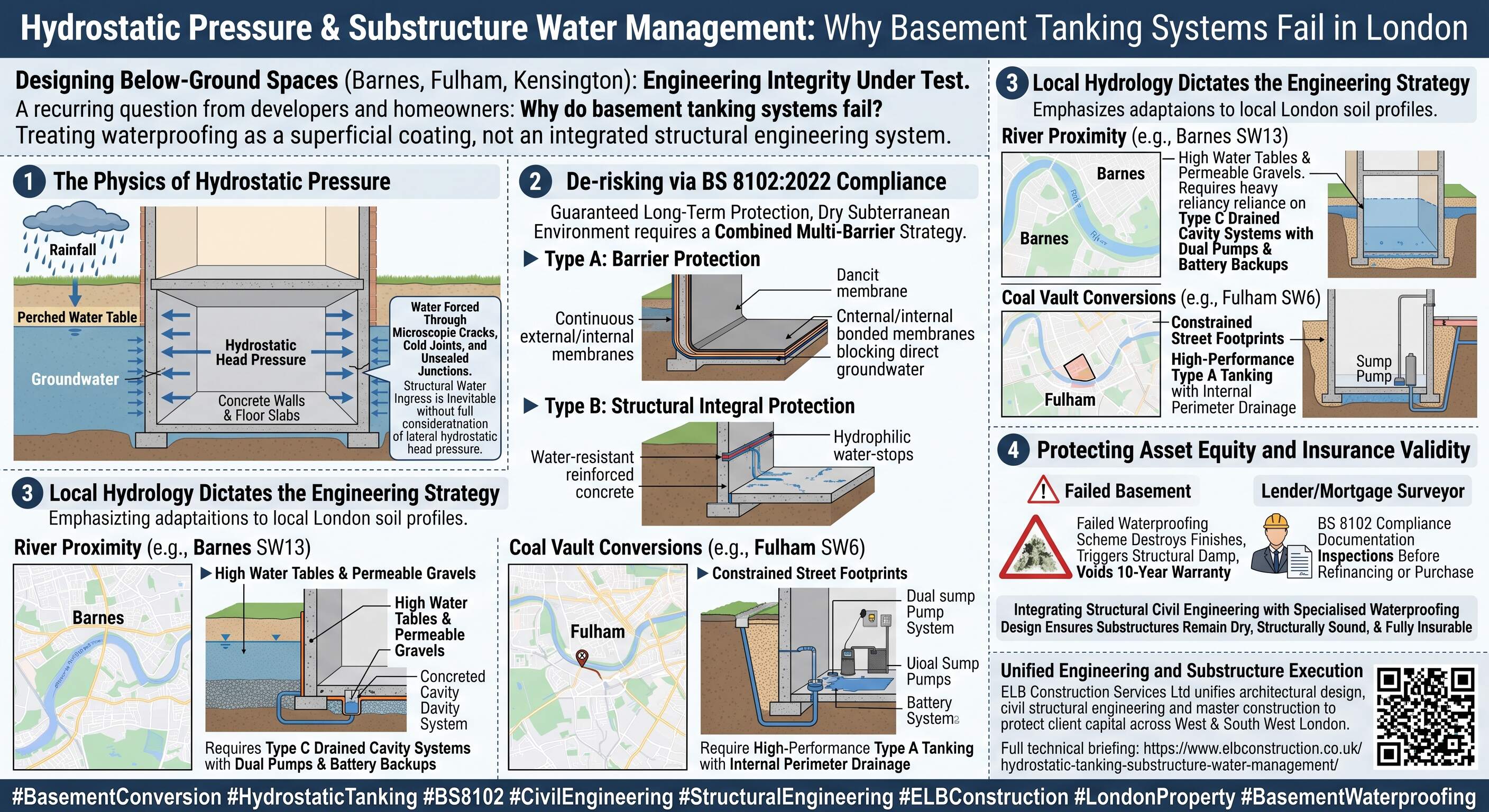
In subterranean urban construction, particularly across Kensington & Chelsea (RBKC), Hammersmith & Fulham (LBHF) and Richmond upon Thames (LBRUT), substructure waterproofing is fundamentally a structural civil engineering challenge, not a cosmetic finishing task.
Fluctuating groundwater tables, perched water pockets in London Clay and permeable Thames gravel layers exert continuous lateral hydrostatic head pressure against retaining walls and floor slabs. When water pressure builds, groundwater forces its way through microscopic concrete voids, construction cold joints and unsealed party wall junctions.
Hydrostatic Head Dynamics and BS 8102:2022 Compliance
Single-barrier waterproofing specifications carry high failure rates in urban infill plots. Under the BS 8102:2022 Code of Practice (Protection of Below Ground Structures Against Water Ingress), achieving a Grade 3 dry internal environment (habitable residential space) requires a combined multi-barrier strategy incorporating Type A, Type B and Type C protection:
Type A (Barrier Protection): Continuous external or internal bonded membranes, or cold-applied elastomeric liquid systems. Applied directly to structural masonry or concrete retaining elements to resist direct hydrostatic head pressure.
Type B (Structural Integral Protection): Reinforced water-resistant concrete engineered to BS EN 1992 (Eurocode 2). Incorporates hydrophobic admixtures and hydrophilic or PVC water-stops along all construction cold joints and kicker pours.
Type C (Drained Cavity Protection): High-density polyethylene (HDPE) studded cavity drain membranes installed to internal walls and floor slabs. Seepage is intercepted and channeled into perimeter drench channels, terminating at dual-submersible pump sumps fitted with non-return valves, high-water alarms and battery-backed auxiliary power units.
Postcode Hydrology: Soil Profiles and Hydrodynamic Variables
Substructure designs must align with localised hydrogeological conditions across West London:
Barnes & Mortlake (SW13 / SW14): Proximity to the River Thames results in high, tidally influenced groundwater tables within highly permeable river terrace gravels. Substructures require heavy reliance on Type C cavity drainage with dual-pump redundancies capable of managing high inflow rates during peak hydro-static events.
Fulham & South Kensington (SW6 / SW7): Subterranean conversions involving historic brick coal vaults present constrained footprints and existing damp masonry. High-performance Type A tanking combined with internal perimeter drainage channels isolates original brickwork while maintaining internal structural floor areas.
Commercial Liability, Structural Guarantees and Valuation Penalties
Substructure water ingress leads directly to physical material degradation, internal wall salt efflorescence and timber decay.
From a financial governance perspective, institutional mortgage lenders, structural warranty providers (such as NHBC or Premier Guarantee) and RICS chartered surveyors mandate complete BS 8102 documentation prior to issuing sign-offs.
Failure to demonstrate compliant design, waterproofing design specialist (WDS) oversight and certified installation invalidates 10-year structural defect guarantees. This routinely results in surveyor down-valuations or conditional retentions during property refinancing and asset transfers.
Integrated Design and Civil Engineering Execution
Addressing hydrostatic risk requires unifying architectural design, civil structural calculations and waterproofing installation under a single design-and-build contract. Engineering out water ingress risk during pre-construction eliminates mid-build sequence clashes between structural ground-workers and waterproofing specialists.
Commenting on substructure engineering requirements across London, a spokesperson for ELB Construction Services Ltd stated:
"Superficial tanking coats fail because they ignore the physical reality of lateral hydrostatic pressure. Operating in high water tables adjacent to sensitive party wall structures demands an engineered, multi-layered defence.
Integrating BS 8102 Type A, B and C systems directly into structural concrete and retaining design ensures long-term watertightness, satisfies warranty insurers and protects underlying asset equity."
Technical Guidance Publication
The complete technical reference on hydrostatic tanking, soil hydrology calculations and BS 8102:2022 compliance frameworks is published on our website.