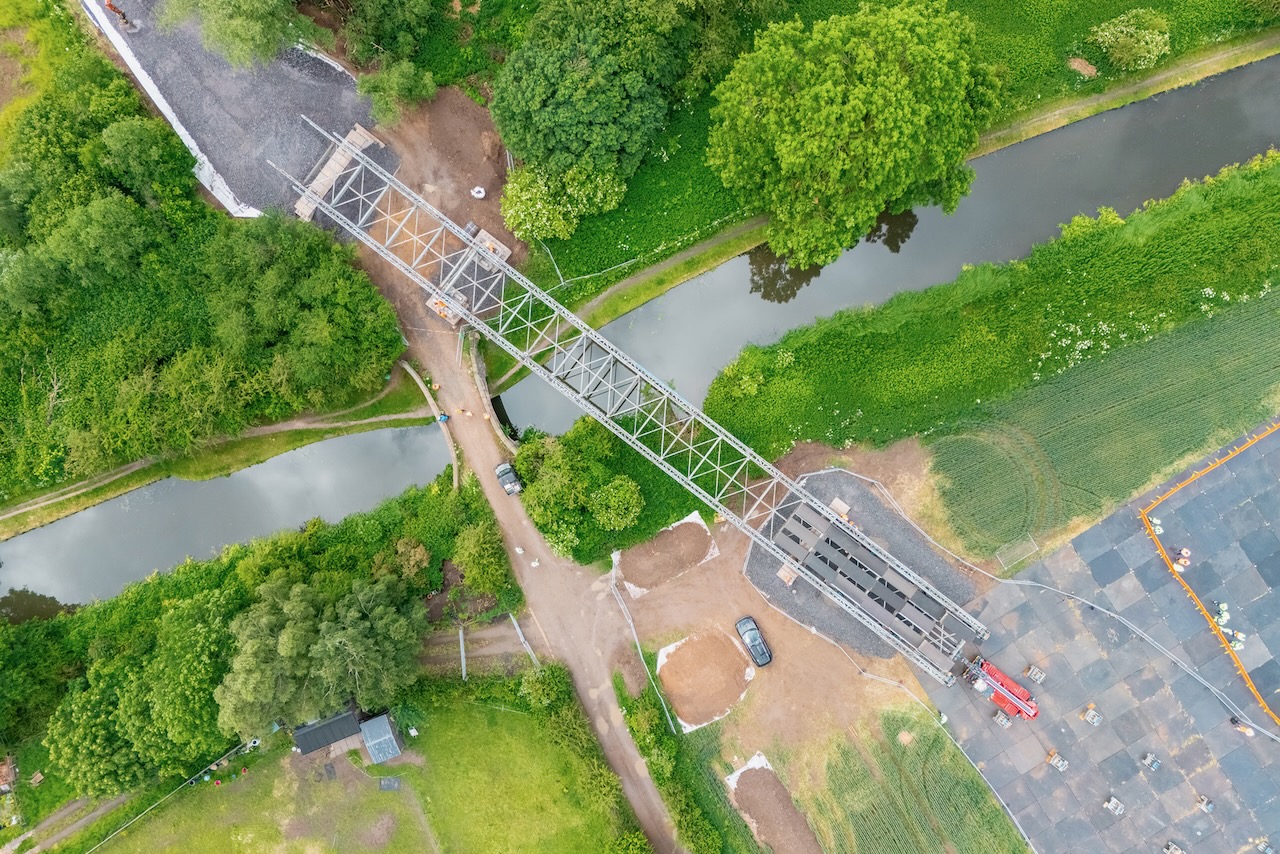
Flooding in the town had caused extensive damage to electrical infrastructure. Repairs would need access across the Trent and Mersey Canal, but only the Grade II listed, 10t weight limit Scotch Bridge was available. Mabey Hire were brought in to help.
Initial proposals had been to lift a new temporary bridge into place, using a 500t crane. But the big crane could not itself access the site, again due to transport infrastructure weight limits.
Andrew Harrison, senior temporary works coordinator at Balfour Beatty, explained, "It was simply not possible. Then there was the added challenge of where to land the bridge on the opposite side of the canal. We were initially faced with a historic contaminated waste site, forcing us to re-design the scheme onto an angle, rather than parallel. Then the discovery of a medieval water mill prevented us from being able to excavate for the temporary abutments.
“All of these challenges and constraints made early engagement and collaboration with Mabey Hire and other stakeholders even more valuable. Being a critical infrastructure project, time was of the essence. It was a collaborative effort to come up with the optimum solution and design, relying on Mabey Hire’s engineering experience with different bridge installations and applications. The final decision was made to launch the bridge, after first assembling the structure on site using modular components.”
Balfour Beatty turned to a Mabey Hire team of senior project engineer, Mara-Maria Alexandru, who worked closely with the team at Balfour Beatty on the scheme design, and a construction team headed up by Robert Williams, site manager, and James Grundy, project manager and coordinator, who supplied and installed the temporary bridge on site.

With a total clear span of 39 metres for the main span, the temporary bridge featured 13 bays, in addition to five bays (15m) for the adjacent span and down ramp, assembled using Mabey Hire’s Compact 200 panel bridge.
Ian Roberts, major project sales manager at Mabey explained, "“Given the site constraints, we tail-launched the bridge with a 5-bay counterweight, whereby the deck was gradually assembled on site and then pushed over to the opposite bank using rollers. As a result of the sloping ground levels, we chose to use the nose of the bridge as the down ramp, which was jacked down onto a lower foundation than the main bridge. This saved Balfour Beatty around 1,500 tonnes of stone on constructing a makeshift ramp.”
To avoid disruption to canal traffic, the Canals & River Trust granted a 30-minute stoppage period for the bridge installation, meaning accuracy and coordination was essential.
Balfour Beatty's Harrison said, “The launch successfully took place on 28th May and the bridge will remain in-situ until the electricity repair works are completed – expected to be in December 2026. The support from Mabey Hire and their engineering teams has been excellent, especially given the design changes that were needed. The proposed scheme design was always promptly adapted and any changes actioned quickly.”
Got a story? Email news@theconstructionindex.co.uk
.gif)